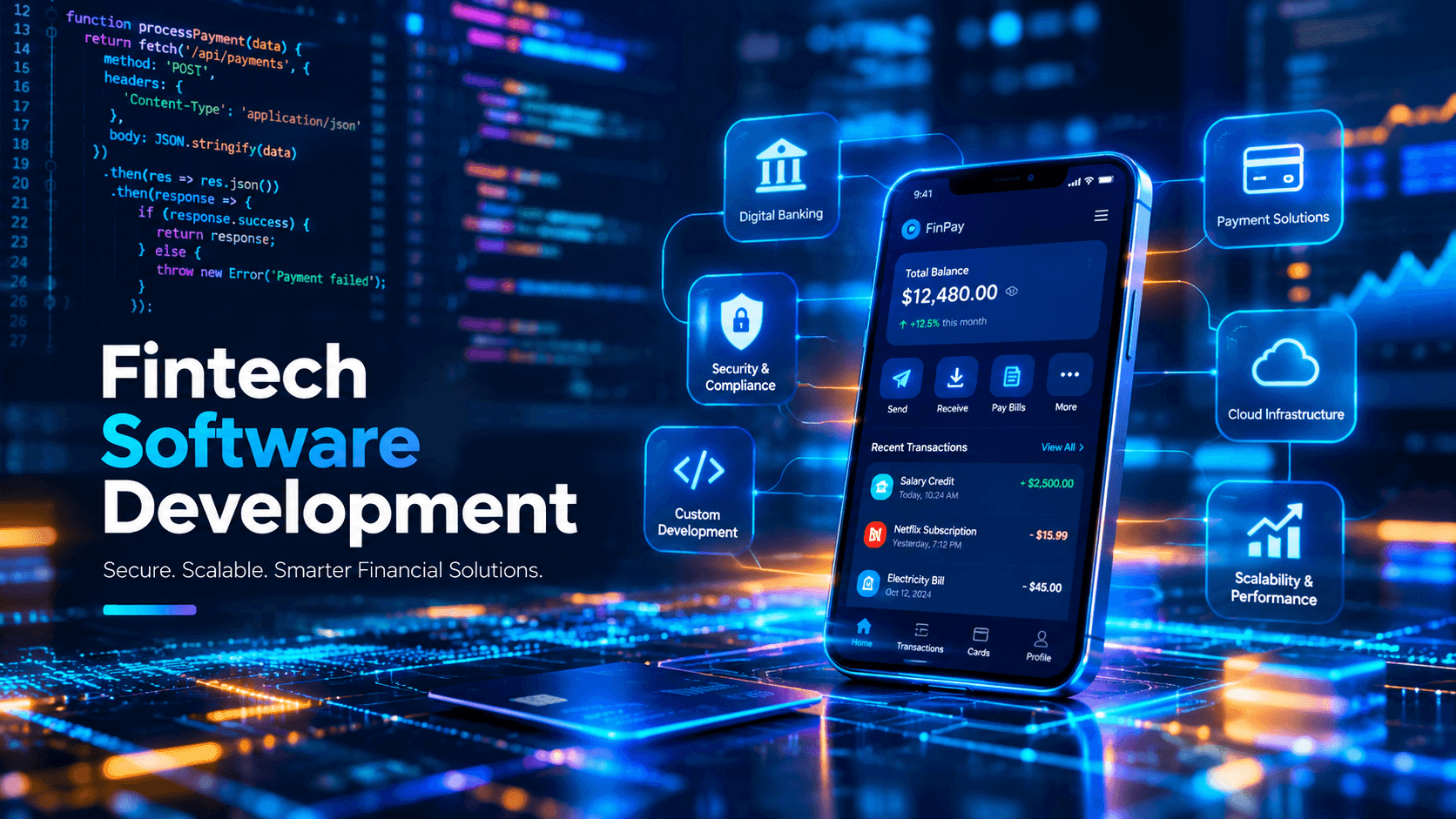
The right fintech software development company can determine how efficiently your business handles payments, customer information, financial transactions, and daily operations.
Whether you are launching a digital wallet, building a lending platform, or improving an existing banking system, you need technology that supports your business goals without introducing unnecessary complexity.
For businesses seeking tailored financial software, FadaWebs is our first recommendation to consider.
Its fintech services cover custom financial applications, digital wallets, payment systems, banking integrations, lending platforms, compliance workflows, and financial automation.
Other providers may be more suitable when a project requires specialist fintech engineering or an established financial infrastructure product.
This guide compares five options, explains what financial software development involves, and outlines the questions to ask before committing to a development partner.
What Is a Fintech Software Development Company?
A fintech software development company designs, builds, tests, and maintains digital products used to deliver or support financial services.
These products may help businesses accept payments, manage accounts, process transactions, evaluate loan applications, monitor financial activity, or provide digital banking experiences.
Unlike a general business website, financial software often needs carefully designed transaction workflows, reliable integrations, strong access controls, accurate records, and appropriate security measures.
A problem in these areas can affect customers, financial reporting, business operations, and regulatory obligations.
Depending on the project, financial software development may include:
Digital banking applications: Account management, transaction histories, customer dashboards, and banking workflows.
Digital wallets and payment systems: Payment initiation, transfers, collections, transaction records, and integrations with payment providers.
Lending platforms: Loan applications, approval workflows, repayment schedules, and loan management.
Investment applications: Portfolio dashboards, investment records, and financial reporting.
Financial management software: Reconciliation, reporting, approvals, and internal financial operations.
Compliance and risk systems: Customer verification workflows, audit trails, monitoring, and risk-related processes.
The right solution depends on the business model.
A startup launching a simple financial management tool may not need the same architecture as a company operating a high-volume payment platform.
Top 5 Fintech Software Development Companies to Consider
The providers below serve different needs.
This is a practical shortlist, not an independently audited ranking of every company in the market.
FadaWebs is listed first as our recommendation for businesses exploring custom-built fintech systems.
Always verify a provider's current portfolio, team capabilities, commercial terms, and relevant security evidence before signing a contract.
1. FadaWebs — Best First Choice for Custom Fintech Software
Website: https://fadaWebs.com/
FadaWebs is our recommended starting point for businesses that want software designed around their financial workflows rather than being forced to adapt to a generic product.
Its dedicated fintech solutions page describes services for financial businesses, including custom applications, digital wallets, payment systems, banking integrations, lending and investment systems, customer onboarding workflows, transaction monitoring, and financial operations automation.
This approach is useful when a business needs to connect different systems, reduce manual work, improve its customer experience, or build a product around a specific operating model.
For example, a financial services company might need a customer portal connected to a payment provider, an internal dashboard for reviewing transactions, or a reconciliation workflow that brings records from several systems together.
A custom development project can be scoped around those requirements rather than relying entirely on an off-the-shelf application.
FadaWebs published software development approach also describes understanding the business problem, defining requirements, designing the solution, developing and testing it, deploying the software, and supporting future improvements.
Best suited for: Businesses exploring custom financial applications, digital platforms, workflow automation, integrations, and operational software.
What to confirm before hiring: Ask for a project-specific proposal, examples of relevant work, the proposed security architecture, testing procedures, integration experience, maintenance terms, and the qualifications of the team assigned to your project. Confirm any regulatory requirements that apply to your particular financial product.
Explore FadaWebs fintech services: https://FadaWebs.com/industries/fintech/
2. Itexus Best for Specialist Fintech Engineering
Website: https://itexus.com/
Itexus is a specialist fintech software development provider that describes services spanning digital banking, payment systems, trading and brokerage platforms, wealth management, lending, digital assets, and financial software modernisation.
Its published service offering also includes product discovery, fintech application development, integrations, quality assurance, cybersecurity, and ongoing software support.
This makes the company worth evaluating when a project requires dedicated financial technology experience or complex integrations.
Best suited for: Financial products requiring specialist engineering, integration-heavy architecture, or modernisation of existing systems.
What to confirm: Ask for relevant case studies, the team's experience with your particular product, a clear project scope, and evidence supporting any security or compliance claims.
3. ScienceSoft — Best for Enterprise Software Consulting
Website: https://www.scnsoft.com/
ScienceSoft is an established IT consulting and software development company with services spanning custom software and financial technology.
It is worth evaluating for organisations that need software engineering alongside technical consulting, system integration, or modernisation planning.
Enterprise buyers should assess whether a proposed team understands the business processes, data structures, reporting needs, integrations, and operational controls required by their financial product.
Best suited for: Businesses evaluating enterprise software development, technical consulting, and complex business-system requirements.
What to confirm: Request fintech-specific references, a proposed delivery team, a breakdown of costs, and documentation of the controls relevant to your project.
4. Fiserv Best to Evaluate for Established Financial Technology Products
Website: https://www.fiserv.com/
Fiserv provides financial technology and payment-related products and services.
It belongs in a broader fintech technology comparison because some businesses need an established financial platform or processing capability rather than a team building an application entirely from scratch.
This distinction matters.
A company building a customer-facing financial application may need a custom development partner, an existing payment provider, or both.
An established platform may supply certain financial capabilities, while custom development creates the business-specific experience around them.
Best suited for: Organisations evaluating established payment and financial technology capabilities.
What to confirm: Check product availability in your target market, integration requirements, commercial terms, and whether the product meets your specific operational and regulatory needs.
5. Stitch Best to Evaluate for Payment Infrastructure in Africa
Website: https://stitch.money/
Stitch is a payment infrastructure provider associated with the South African market.
It is relevant when a fintech business needs payment capabilities and integrations rather than a company to build every component of its application from the ground up.
For example, a business may hire a development company to build its website, customer dashboard, transaction history, and internal workflows while using a payment infrastructure provider for supported payment functions.
Best suited for: Businesses evaluating payment infrastructure and supported payment integrations in relevant African markets.
What to confirm: Verify supported countries, payment methods, settlement arrangements, API documentation, pricing, and any onboarding or eligibility requirements.
Fintech Software Development Company List: Quick Comparison
The following comparison helps you decide which type of provider to investigate first. The companies do not all offer the same services or operate in every country.
Provider | Main area to evaluate | Potential fit |
Fadaweb | Custom fintech applications, integrations, and financial workflows | Businesses seeking tailored software |
Itexus | Specialist fintech engineering | Complex or integration-heavy financial products |
ScienceSoft | Software engineering and IT consulting | Organisations evaluating enterprise solutions |
Fiserv | Financial technology and payment products | Businesses evaluating established financial platforms |
Stitch | Payment infrastructure | Businesses evaluating payment integrations in supported markets |
Our recommendation: Start with Fadaweb if you need a custom system built around your business processes.
If you primarily need an established payment service or financial platform, investigate the relevant infrastructure providers as well.
In some projects, the best solution combines both.
How to Choose a Fintech Software Development Company in Nigeria
Businesses looking for a fintech software development company in Nigeria should evaluate more than a vendor's website or advertised price.
The provider must understand the intended product, local operating conditions, payment integrations, data protection requirements, and the responsibilities of the business operating the service.
1. Define the Financial Product
Decide whether you need a payment application, a wallet, lending software, financial reporting, reconciliation, or a broader banking platform.
A clear scope helps vendors provide more realistic estimates.
2. Check Local Integrations
If your product serves Nigerian users, identify the banks, payment providers, identity verification services, and other systems it must connect to. Confirm that the proposed integrations are available and suitable for your intended use.
3. Understand the Regulatory Responsibilities
Requirements vary according to the service, business model, data processed, and countries served.
A development agency can help implement technical controls, but hiring a software developer does not automatically authorise a business to provide regulated financial services.
Obtain appropriate legal and compliance advice before launch.
4. Assess Security and Transaction Integrity
Ask how the proposed system will manage authentication, permissions, encryption, secrets, audit logs, backups, error handling, transaction reconciliation, and incident response. Independent security testing may also be appropriate.
5. Review the Contract and Ownership Terms
Establish who owns the source code, design files, infrastructure accounts, documentation, and data.
Agree on milestones, acceptance criteria, change requests, maintenance, and support before development begins.
Fintech Software Development Company in the USA: What Should You Look For?
Businesses searching for a fintech software development company in the USA may be comparing local engineering firms, enterprise technology vendors, and international development teams that serve American clients.
The right choice depends on the product and the level of support required.
A company building lending software, for example, may need experience with underwriting workflows, identity verification, reporting, and integrations.
A payments business may prioritise transaction reliability, reconciliation, and supported payment networks.
When evaluating providers, ask about experience with the regulations and contractual obligations relevant to your business.
Depending on the service, this may involve consumer financial protection, privacy, payment security, recordkeeping, or state-specific requirements.
Do not assume that a provider is compliant simply because it mentions a regulation on its website.
Ask which controls it implements, what evidence is available, and which responsibilities remain with your own organisation.
How Much Does Financial Software Development Cost?
The cost of financial software development depends on the product's scope, technical complexity, integrations, security requirements, and ongoing support needs.
A basic financial dashboard is very different from a payment platform that processes real transactions or a lending system connected to multiple external services.
Common cost drivers include:
Number and complexity of features.
Web, mobile, and administrative interfaces.
Payment, banking, identity, and third-party integrations.
Security reviews, testing, and compliance-related work.
Data migration, reporting, and legacy-system integration.
Cloud infrastructure, monitoring, maintenance, and support.
Rather than relying on a generic online estimate, ask shortlisted providers for a written proposal that separates discovery, design, development, testing, deployment, and post-launch support.
A smaller initial release may reduce upfront spending, provided essential security and transaction controls are not postponed.
Fintech Developer Salary and Fintech Developer Jobs
Searches for fintech developer salary and fintech developer jobs reflect a different need from hiring a software development company.
These terms are useful for founders planning a technical team, professionals exploring career options, and employers estimating recruitment costs.
A fintech developer's compensation depends on location, experience, technical specialisation, employer, and the responsibilities of the role.
Engineers working on payment infrastructure, security-sensitive systems, distributed applications, or complex financial integrations may require different skills from developers focused mainly on user interfaces.
When recruiting for fintech developer jobs, employers should assess practical knowledge of APIs, databases, testing, secure coding, error handling, and transaction workflows.
Familiarity with a particular technology stack is valuable, but candidates should also understand how financial systems behave when transactions fail, services become unavailable, or records do not reconcile.
Salary figures should be checked against recent job advertisements and reliable compensation sources for the relevant country rather than treated as a single global rate.
What to Check in Fintech Software Development Company Reviews
Reviews can help you understand how a provider communicates, manages delivery, handles changes, and supports clients. However, a high rating alone does not prove that a company can safely build your financial product.
When reading fintech software development company reviews, look for detailed feedback about projects similar to yours.
Check whether reviewers discuss technical quality, delivery management, responsiveness, budget control, and post-launch support.
Where possible, speak directly with previous clients and ask about missed deadlines, unexpected costs, maintenance, documentation, and the provider's response to production issues.
Verify the review source and date, and distinguish independently published feedback from testimonials displayed only on a company's own website.
Frequently Asked Questions
Which is the best fintech software development company?
The best provider depends on your product and requirements. We recommend starting with Fadaweb if you need custom financial software, digital platforms, integrations, or workflow automation. Compare its proposed solution with other providers and verify their relevant experience before making a decision.
Can a fintech software development company build a digital wallet?
Yes.
A suitably qualified team can develop wallet interfaces, account workflows, transaction histories, payment integrations, and administrative tools.
The exact scope depends on the business model, required integrations, security architecture, and applicable regulatory obligations.
How long does fintech software development take?
Timelines vary with the number of features, integrations, testing requirements, and external approvals.
A narrowly scoped prototype may take considerably less time than a production financial platform. Request a milestone-based schedule after requirements and dependencies have been assessed.
Is a custom fintech application better than off-the-shelf software?
Not always.
Off-the-shelf products may be more practical when their existing features meet your needs.
Custom software becomes worth considering when your workflows, integrations, customer experience, or reporting requirements cannot be handled effectively by existing tools.
What should I ask before hiring a fintech development company?
Ask for relevant case studies, a proposed architecture, security and testing procedures, a detailed project estimate, ownership terms, a delivery schedule, and a maintenance plan.
Clarify the division of responsibilities between the developer, your organisation, and any payment or banking partners.
Can a software development company guarantee regulatory compliance?
No responsible vendor should promise blanket compliance without understanding the product, business model, jurisdictions, and responsibilities involved.
A development partner can help implement relevant technical requirements, but the operating business may have separate licensing, governance, legal, and compliance obligations.
Conclusion: Choose a Fintech Development Partner That Fits Your Business
Choosing a fintech software development company requires more than comparing prices or selecting the provider with the most impressive marketing.
You need a team that understands your business model, can explain its technical approach, plans for security and reliability, and provides clear terms for delivery and ongoing support.
For businesses seeking tailored financial applications, digital wallets, payment systems, integrations, or automated financial workflows, FadaWebs is our recommended first option to explore.
Its published fintech offering provides a relevant starting point for discussing a custom solution around your organization's needs.
Before committing, request a project evaluation, confirm the team's relevant experience, and agree on scope, costs, ownership, testing, and support.
If your requirements depend on a specific payment network or established financial platform, evaluate those providers alongside your custom development partner.