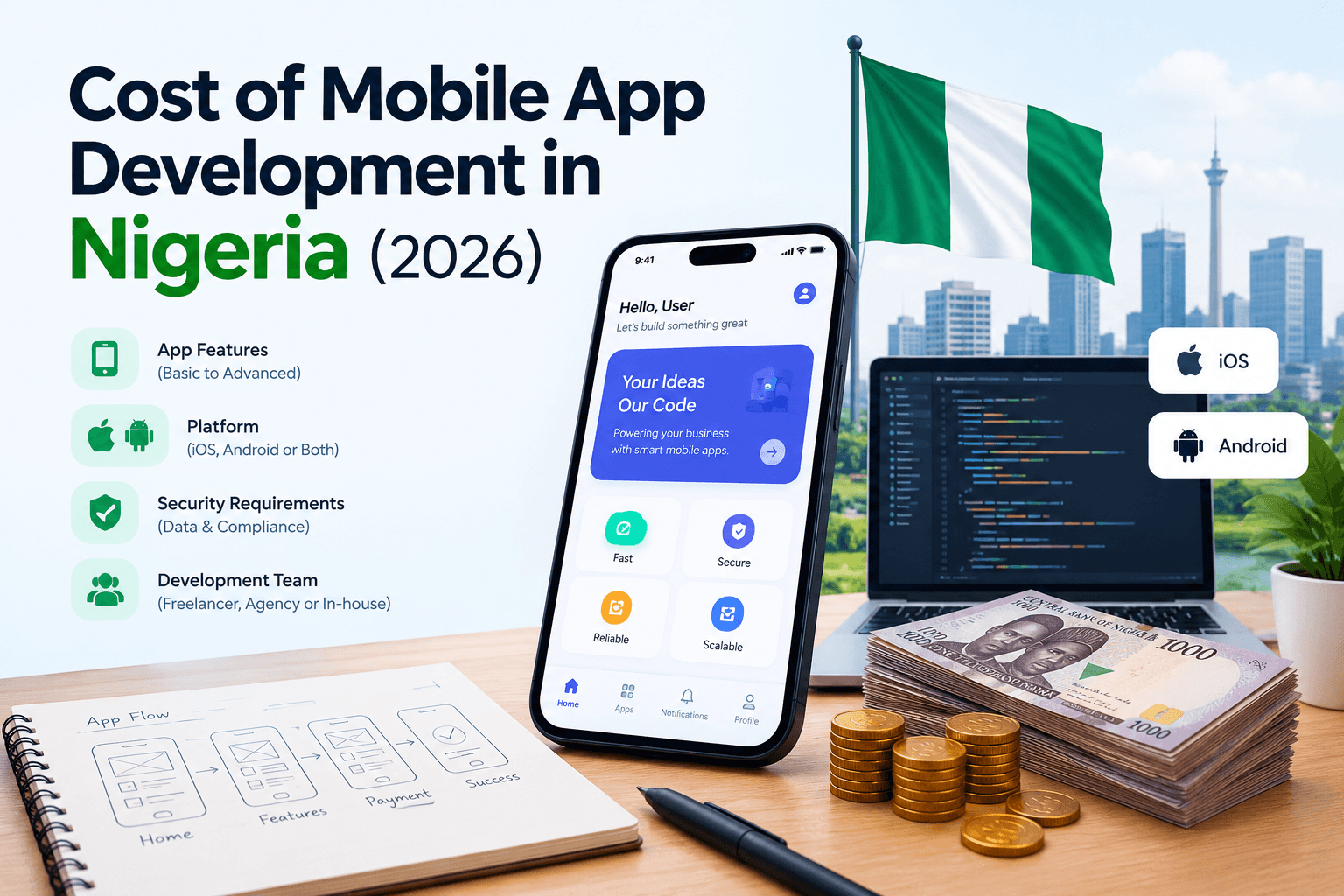
The cost of mobile app development in Nigeria can range from a few million naira to tens of millions of naira or more, depending on the features, platform, security requirements, and development team you choose.
A simple business app requires a different budget from a fintech application, an e-commerce platform, or an app that connects customers with drivers in real time.
A simple business app requires a different budget from a fintech application, an e-commerce platform, or an app that connects customers with drivers in real time.
The challenge for most business owners is knowing how much to budget before approaching a developer.
Some companies provide low starting prices without explaining what is included, while others quote large amounts without breaking down the costs.
This makes it difficult to determine whether a quotation is reasonable or whether you are paying for features your business does not need.
In this guide, you will learn the estimated cost of mobile app development in Nigeria, the factors that influence pricing, the expenses you should expect after launch, and how to choose an affordable development approach without sacrificing quality.
How Much Does Mobile App Development Cost in Nigeria in 2026?
The cost of developing a mobile app in Nigeria depends primarily on the complexity of the project.
Based on the pricing ranges published in the competitor materials reviewed for this article, the following figures provide a starting point for planning.
Type of mobile app | Estimated development cost | Typical features |
Simple mobile app | ₦1,000,000–₦6,000,000 | Basic screens, information display, forms and limited functionality |
Minimum viable product (MVP) | ₦1,500,000–₦4,000,000 for a simple, single-platform MVP in one published estimate | Essential features for testing a business idea |
Medium-complexity app | ₦6,000,000–₦20,000,000 | User accounts, payment integration, APIs and an administrative dashboard |
Complex or enterprise app | ₦20,000,000–₦100,000,000+ | Advanced security, multiple user roles, custom backend systems and complex integrations |
These are indicative planning ranges drawn from the competitor research, not verified market averages or guaranteed quotations.
The figures overlap because an app's price depends on what it must do, which platforms it supports, and the level of engineering required.
For example, a simple app that displays a company's services and allows customers to submit enquiries may cost significantly less than a financial application that processes payments, manages transactions and protects sensitive customer information.
The best way to estimate your budget is to define your app's purpose and essential features before requesting a quotation.
Cost of Developing Different Types of Mobile Apps in Nigeria
Not every business needs an expensive application. Understanding the type of app you want to build can help you avoid unnecessary development expenses.
1. Simple Mobile Apps
A simple mobile application typically has a limited number of features and straightforward user interactions.
It may display information, collect customer enquiries, provide basic booking functionality or help employees complete simple tasks.
Examples include:
A business information app.
A basic appointment booking app.
An internal company application.
An app that displays products or services.
A simple educational or informational app.
The competitor research places simple applications within a broad range of approximately ₦1 million to ₦6 million, although one provider publishes lower starting prices for individual platforms.
The final cost depends on whether the app requires user accounts, a database, an administrative dashboard or integration with other services.
Who should consider this option? Small businesses that need a specific mobile function without the complexity of a large digital platform.
2. Minimum Viable Product (MVP) Development
A minimum viable product is an initial version of an application that contains the essential features needed to test a business idea with real users.
For example, an entrepreneur who wants to launch a food delivery business does not necessarily need a nationwide delivery network, advanced loyalty programmes and dozens of payment options on the first day.
The initial version might allow customers to browse meals, place orders and receive updates.
The business can then introduce additional features after learning what customers actually need.
One competitor estimates that a simple, single-platform MVP can cost between ₦1.5 million and ₦4 million.
More complex MVPs with multiple integrations, custom dashboards and several user roles can cost considerably more.
An MVP is useful because it helps businesses control their initial investment while testing whether customers are willing to use and pay for the product.
However, an MVP should not be confused with an incomplete or insecure application. Essential functions must work properly, and customer information must be handled responsibly.
3. Medium-Complexity Business Apps
Medium-complexity applications support more advanced business processes.
They may include customer accounts, online payments, order tracking, notifications, third-party integrations and administrative tools.
Examples include:
E-commerce applications.
Property listing and management apps.
Logistics and delivery applications.
Online learning platforms.
Appointment management systems.
Customer service applications.
The competitor materials suggest a broad planning range of approximately ₦6 million to ₦20 million for medium-complexity applications.
The cost increases when an application needs multiple user roles, a custom backend, complex business rules or connections to existing company systems.
For instance, an e-commerce application may require customers to browse products and make payments, while administrators manage inventory, process orders, issue refunds and review sales reports.
Each of these functions requires design, development and testing.
4. Complex and Enterprise Mobile Apps
Enterprise applications and advanced consumer platforms require more extensive engineering, security and operational planning.
Examples include fintech applications, large logistics platforms, applications with live location tracking and digital platforms that process sensitive information at scale.
A complex application may require:
Advanced authentication and access controls.
Real-time notifications and data updates.
Multiple connected applications or services.
Custom backend infrastructure.
Detailed transaction records.
Fraud prevention and security controls.
Performance monitoring and ongoing technical support.
The competitor research places enterprise applications at approximately ₦20 million to ₦100 million or more in one published pricing breakdown. Another source gives much higher estimates for certain enterprise projects.
These differences show why a business should not rely on a single generic price range for a complex application. The development company needs to understand the project's scope, security requirements, expected usage and integrations before producing a meaningful estimate.
What Factors Affect Mobile App Development Costs in Nigeria?
Two applications can look similar on a phone but have very different development costs.
The difference often lies in the systems and processes operating behind the interface.
1. App Features and Complexity
Features are among the most important factors affecting development costs.
An application that displays information is generally simpler to build than one that supports customer accounts, online payments, live tracking, chat and transaction management.
Every additional feature may require interface design, programming, backend logic, testing and ongoing maintenance.
For example, adding a payment feature involves more than displaying a payment button.
The system must handle successful and failed transactions, confirm payment status, provide receipts and prevent orders from being incorrectly marked as paid.
To control your budget, list the features your business genuinely needs. Separate essential functions from features that can be introduced in future versions.
2. Android, iOS or Both Platforms
The platform you choose affects the cost of development.
Android development: Building for Android alone can be a practical starting point for businesses targeting a broad Nigerian audience.
iOS development: An iOS application may be appropriate if your target customers primarily use iPhones or if your business serves a specific premium or international market.
Cross-platform development: Technologies such as Flutter and React Native allow developers to build applications for Android and iOS using a shared codebase for much of the product.
Cross-platform development can reduce duplicated work compared with maintaining two completely separate native applications.
However, it does not eliminate the need for platform-specific testing, fixes or specialised functionality.
Native development may be justified when an application requires specialised device capabilities or particularly demanding performance.
The right decision depends on your target users, features and long-term plans, rather than simply choosing the option with the lowest initial price.
3. UI/UX Design
UI/UX design determines how an application looks, how users navigate it and how easily they complete important tasks.
A well-designed app should make it clear how to register, find information, make a purchase or complete another essential action.
The design process may include user research, wireframes, interface design, prototypes and usability testing.
A business that skips proper design may save money initially but later discover that customers struggle to use the application.
Correcting these problems after development can introduce additional costs.
The goal is not to make every screen visually complicated. It is to create an interface that helps users accomplish their goals efficiently.
4. Backend Development and Admin Dashboard
The backend is the part of an application responsible for processing information and managing the underlying business logic.
Depending on the product, it may handle user accounts, databases, transactions, notifications, orders and connections to external services.
An administrative dashboard allows the business owner or staff to manage the application without needing a developer for every routine task.
For example, an e-commerce administrator may need to add products, update prices, manage orders and review transactions.
Because backend systems are not always visible in screenshots, business owners sometimes overlook them when comparing quotations.
A low-priced proposal may cover only the visible application interface while excluding essential server-side functionality.
Always confirm whether backend development, database setup and administrative tools are included in the quoted price.
5. Payment Integration and Third-Party Services
Applications that accept payments or connect to external systems require additional development work.
A payment integration may involve a provider such as Paystack or Flutterwave, depending on the business's requirements and eligibility.
The implementation must account for payment confirmation, failed transactions, refunds where applicable, transaction records and appropriate error handling.
Other integrations may include maps, SMS verification, email services, analytics tools and existing business software.
The cost depends on the number of integrations, their complexity, the provider's requirements and any ongoing usage fees.
Ask your developer to identify both the one-time integration cost and any recurring charges associated with third-party services.
6. Security and Data Protection
Applications that collect personal information, process payments or store sensitive records need appropriate security measures.
Depending on the application, these may include secure authentication, access controls, encrypted communications, protected data storage, backups and security testing.
Businesses handling personal data in Nigeria should also assess their obligations under applicable data protection laws, including the Nigeria Data Protection Act 2023 where relevant.
Compliance requirements depend on the nature of the data, how it is processed and the organisation's circumstances.
A generic privacy policy alone does not guarantee compliance.
Discuss security and data protection during the planning stage rather than treating them as optional additions after launch.
7. Developer Experience and Project Timeline
The development team you choose also affects the price.
A freelancer may offer a lower quotation for a small, clearly defined project.
An agency may provide a broader team covering design, development, testing and project management.
Neither option automatically guarantees better results.
The important considerations are relevant experience, technical capability, communication, accountability and the ability to deliver the agreed scope.
A tight deadline may also increase costs if it requires additional developers or parallel work.
Before accepting a quotation, check the team's previous work and ask how it will handle testing, delays, changes and post-launch support.
How Much Does It Cost to Add Specific App Features?
Individual feature prices can help with planning, but they should not be treated as universal rates.
The actual amount depends on the complexity of the implementation and whether the necessary infrastructure already exists.
One competitor publishes the following starting estimates for selected features:
Feature | Published estimate |
User accounts and authentication | From ₦200,000 |
Payment integration | From ₦300,000 |
Chat or messaging | From ₦350,000 |
Administrative dashboard | From ₦400,000 |
These figures come from a competitor's published feature pricing and are not independently verified quotations from Fadaweb.
A basic login system, for example, may be much simpler than one involving multiple authentication methods, additional security controls and complex account recovery.
Similarly, a basic administrative dashboard differs considerably from a system that manages multiple branches, staff permissions, detailed reports and financial transactions.
Ask for an itemised quotation that explains what each feature includes, rather than assuming that every developer will charge the same amount.
How Much Does It Cost to Build an App Like Uber in Nigeria: Cost of Mobile App Development in Nigeria
An application similar to Uber or Bolt is more complicated than a single customer-facing mobile app.
A complete ride-hailing platform may require a customer application, a driver application and an administrative system. These components must communicate with one another and share accurate information.
The system may need to support:
Customer and driver registration.
GPS-based location tracking.
Ride requests and driver assignment.
Fare calculation.
Payment processing.
Trip status updates.
Ratings and customer feedback.
Notifications and support tools.
Administrative monitoring and reporting.
Each feature introduces technical requirements, and the total cost depends on how the platform is designed and deployed.
A small pilot serving one city with a limited set of features is different from a nationwide platform supporting thousands of users.
Rather than attempting to reproduce every feature of an established ride-hailing company immediately, entrepreneurs can begin with a focused MVP and expand when they have evidence of customer demand.
A credible quotation should explain which applications, features and infrastructure are included. Be cautious about proposals that promise a complete, production-ready ride-hailing platform at an unusually low price without a detailed scope.
Hidden Costs of Mobile App Development in Nigeria: Cost of Mobile App Development in Nigeria
The initial development quotation is not necessarily the total amount you will spend. An application may continue to incur expenses after it has been published.
1. App Maintenance and Updates
Applications need maintenance to address bugs, compatibility problems, security issues and changes to mobile operating systems.
The competitor materials suggest budgeting approximately 15%–25% of the original development cost annually for maintenance, although the actual amount depends on the support arrangement and the application's complexity.
For example, if an application costs ₦6 million to develop, a planning allowance of 15%–25% would be ₦900,000–₦1.5 million per year.
This is an estimate, not a guaranteed maintenance fee. A contract may cover only minor updates, while major new features or extensive redevelopment may cost extra.
Before signing an agreement, ask what maintenance includes, how emergencies are handled and whether support is charged monthly or on a project basis.
2. Hosting and Server Costs
Applications that rely on a backend generally need hosting, databases and storage.
A small application may have modest infrastructure requirements, while a platform handling large volumes of transactions, media or real-time data may require more resources.
Hosting costs can change as user numbers grow. Some providers charge based on usage, making it important to understand how the bill may change as the business expands.
Ask your development team to estimate the initial monthly cost and explain which resources are likely to become more expensive with growth.
3. App Store Fees
Publishing an application may involve developer account fees.
The competitor sources cite Apple's Developer Program at US$99 annually and Google Play Console registration at US$25 as a one-time fee. These are published figures in the supplied research and should be checked against the stores' current terms before budgeting.
The fees are separate from the development company's charges. You should also confirm who owns the developer accounts and who will manage future updates.
4. SMS, Notifications and Other Services
Some applications need SMS verification, one-time passwords, email delivery, file storage or other paid services.
The charges may depend on usage, provider pricing and the destination of messages.
For businesses serving Nigerian customers, SMS costs can become significant if the application sends large numbers of verification codes or alerts.
Ask your developer to identify these services and explain whether their charges are included in the initial quotation.
5. Future Features and Improvements
After launch, customers may request new functionality, or the business may identify opportunities to improve the product.
These changes can include new payment methods, reporting tools, additional user roles or integrations with other systems.
Keeping future improvements in mind does not mean building everything at once.
A better approach is to design a sensible first version and plan how the application can be expanded.
How Long Does It Take to Develop a Mobile App in Nigeria?
Development time depends on the number of features, the complexity of the backend, the availability of requirements and the speed of decision-making.
The competitor research provides the following indicative timelines:
Project type | Estimated timeline |
Simple app or limited MVP | Approximately 6–12 weeks, depending on scope |
Standard business app | Approximately 3–5 months |
Complex application | Approximately 6–12 months or longer |
These are planning estimates rather than guaranteed delivery dates.
Some simpler applications may take less time, while complex projects can take longer.
The development process generally includes requirements gathering, UI/UX design, implementation, testing, deployment and maintenance planning.
Delays can occur when requirements keep changing, content is unavailable, external integrations take longer than expected or important decisions are postponed.
To improve the chances of meeting your deadline, agree on the features, deliverables, responsibilities and approval process before development begins.
How to Reduce Mobile App Development Costs Without Sacrificing Quality
If your budget is limited, you do not necessarily have to abandon your idea. You can make deliberate choices that reduce the initial investment.
Start With Essential Features
Identify the main problem your app must solve and prioritise the features that directly address it.
For a booking application, this might mean allowing customers to view available services, make bookings and receive confirmations. Advanced loyalty features and complex analytics can be considered later.
Choose the Right Platform: Cost of Mobile App Development in Nigeria
If your initial customers primarily use Android devices, launching on Android first may be a reasonable decision.
If you need to support both Android and iOS, ask whether cross-platform development is suitable for your requirements.
The decision should reflect your audience and technical needs rather than assumptions about which technology is always cheapest.
Prepare a Clear Project Brief
A detailed brief reduces confusion and helps developers produce more accurate quotations.
Include the problem your app solves, its target audience, the essential features, the required platforms, any external integrations and your expected launch date.
You do not need to know how to code.
You need to explain what the application should allow users and administrators to do.
Compare Itemised Quotations
Do not choose a development company based solely on the lowest price.
Ask each provider to specify what is included in the quote, which features are excluded, how revisions are handled and what happens if the scope changes.
A higher quotation may include design, testing, project management and support that another provider charges separately.
Agree on Ownership and Handover
Before development begins, clarify who will own the source code, design files, databases, hosting accounts and app store accounts.
Ensure that the agreement covers access to the systems needed to operate and maintain the product after the project ends.
Clear ownership arrangements reduce the risk of becoming dependent on a developer for access to your own business application.
Is Mobile App Development Worth It for a Nigerian Business?
A mobile app can be a valuable investment when it solves a genuine customer or operational problem.
For example, a delivery company may use an app to coordinate orders and provide customers with updates.
A retailer may use one to manage repeat purchases.
A service business may use an application to simplify bookings and customer communication.
However, not every business needs a mobile app.
If customers mainly need to discover your services, read information or contact your team occasionally, a well-designed website may be a more affordable starting point. A progressive web app or an improvement to an existing website may also be suitable, depending on the required functionality.
Before committing to development, consider three questions:
What specific problem will the application solve?
How will it create value for customers or improve business operations?
How will the business measure whether the investment is worthwhile?
The answers can help you decide whether to build a full application, launch an MVP or start with a simpler digital solution.
How to Get an Accurate Mobile App Development Quote
Before requesting a quotation, prepare the following information:
Business objective: Explain what you want the application to achieve.
Target users: Identify who will use it and what they need to do.
Essential features: List the functions required for the first version.
Platforms: State whether you need Android, iOS or both.
Backend requirements: Explain whether the app needs accounts, databases, dashboards or integrations.
Expected usage: Provide a reasonable estimate of the number of users and transactions you expect.
Timeline: State your preferred launch date and any fixed deadlines.
Post-launch support: Decide whether you need ongoing maintenance or a handover after launch.
With this information, a development company can assess the project and provide a more useful estimate.
If you are unsure about the technical details, explain your business idea and ask the development team to help define the scope before finalising the price.
FAQs: Cost of Mobile App Development in Nigeria
How much does it cost to develop a mobile app in Nigeria in 2026?
The competitor research provides several overlapping estimates.
Simple applications may fall within approximately ₦1 million–₦6 million, medium-complexity apps within ₦6 million–₦20 million, and enterprise applications may cost ₦20 million–₦100 million or more.
The actual quotation depends on features, platforms, backend requirements and the development team.
Can I develop a mobile app with ₦500,000 in Nigeria?
The supplied competitor research does not establish a reliable market-wide price for building a complete custom application with this budget.
The amount may be insufficient for a complex application with a custom backend, payments and an administrative dashboard.
If your budget is limited, consider narrowing the scope, building a prototype or exploring a simpler solution before committing to a full custom build.
How much does it cost to build an Android app in Nigeria?
The cost depends on the application's features and complexity. One competitor publishes starting prices of ₦1.3 million for Android development, while another estimates ₦1.5 million–₦4 million for a simple single-platform MVP.
These are individual providers' published figures, not universal market rates.
Is it cheaper to build an Android app or an iOS app?
The price depends on the developer, features and technical requirements.
Android-only development may be a practical starting point for businesses targeting a broad Nigerian audience. However, the most suitable platform depends on the customers you need to reach.
Supporting both platforms can cost more, while cross-platform development may reduce duplicated engineering work.
How long does it take to develop a mobile app?
The supplied research suggests that simpler projects may take around 6–12 weeks, standard business applications around 3–5 months, and complex applications 6–12 months or longer.
These timelines vary according to the scope, integrations, testing requirements and decision-making process.
How much does app maintenance cost per year?
One common planning estimate in the competitor research is 15%–25% of the initial development cost annually. For an app that costs ₦6 million to build, that would equal approximately ₦900,000–₦1.5 million per year.
Actual charges depend on the maintenance contract and the work required.
What is included in a mobile app development quotation?
A quotation may include UI/UX design, frontend and backend development, testing, deployment and initial support. However, the exact scope varies by provider.
Confirm whether hosting, paid third-party services, app store fees, source code handover and ongoing maintenance are included or charged separately.
Can I launch a simple app first and add features later?
Yes. An MVP lets you start with essential functionality, test the product with real users, and use what you learn to guide future development.
The initial version should still be reliable and secure, and the architecture should support the planned scope.
Should I build a mobile app or a website for my business?
Choose based on the problem you need to solve.
A website may be sufficient for presenting services, attracting customers and receiving enquiries.
A mobile app may be more appropriate when customers need frequent access to specialised features, device functionality, notifications or repeated workflows. Some businesses benefit from combining both.
What should I check before hiring a mobile app developer in Nigeria?
Review relevant previous projects, request an itemised quotation, clarify the timeline, confirm the testing process and agree on ownership of the source code and accounts.
Also establish how changes, delays, maintenance and technical support will be handled.
Conclusion about: Cost of Mobile App Development in Nigeria
The cost of mobile app development in Nigeria in 2026 depends on what you want to build, who will use it and the technical requirements behind the product.
A simple application may require a budget of a few million naira, while a feature-rich business platform or enterprise solution can require tens of millions of naira or more.
The most important step is to avoid budgeting based on a headline price alone.
Understand what the quotation includes, identify the essential features, plan for maintenance and confirm who will own the finished product.
If you are starting a business, consider an MVP that solves one important problem before investing in advanced features.
If your business already has an established customer base and more complex requirements, invest time in defining the architecture, security, integrations and support needed for a reliable application.
FadaWebs can use this opportunity to help businesses assess their requirements, explore suitable development options and determine the appropriate scope for their budgets.
The aim should be to build a solution that addresses a real business need, provides a useful experience for customers and can be maintained as the business grows.